If you want a good report of the title story, read Carbon Brief.
If you want a bad one, read Roger Harrabin.
You'll notice that the authors of the report concerned anticipate that their findings will be seized upon by the climate change sceptics, and go to pains to show that their arguments are invalid.
So what does Roger Harrabin do? He goes to the climate change sceptics and relays their arguments in the third sentence.
The despite the warning from the scientist the BBC asked to assess its science coverage:
"Science turns on evidence. Balance in science is not the same as balance in politics where politicians can have a voice however barmy their ideas are. They're not taking this on board. Why, I don't know."theguardian.com
So what barmy things do the "sceptics" say?
(Well first let's point out the irony of climate sceptics touting a study based on the output of computer models that demonstrates that human activity has an observable effect on the climate.)
"The magnitude of the increase in vegetation appears to be considerably larger than suggested by previous studies. This suggests that projected atmospheric CO2 levels in IPCC scenarios are significantly too high, which implies that global temperature rises projected by IPCC models are also too high, even if the climate is as sensitive to CO2 increases as the models imply."Says one.
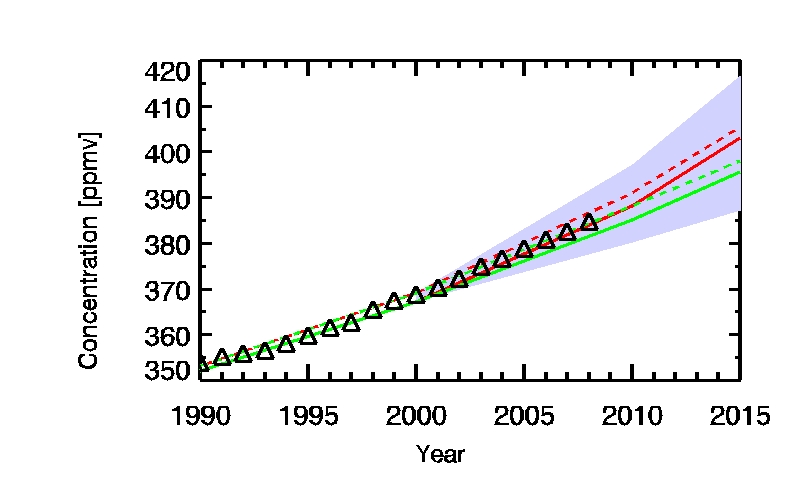
Well empirically, CO2 concentration isn't observed to be diverging (significantly) from IPCC projections, but this sceptic is obviously more interested in the hypothetical (i.e. what is projected from climate models), and what may happen in the future.

Another says:
"It is inappropriate to dismiss the arguments of the so-called contrarians, since their disagreement with the consensus reflects conflicts of values [?!] and a preference for the empirical (i.e. what has been observed) versus the hypothetical (i.e. what is projected from climate models).Well the greening of the earth due to an increase in CO2 the atmosphere was predicted by science. (See quote above.) The fact that prediction is now an empirical observation ("although the magnitude appears to be considerably larger than suggested by previous studies") should make us doubt "the hypothetical predictions of climate models"?
Maybe they are an underestimate too?
One prefers the hypothetical over the empirical and the other the empirical over the hypothetical.
Barmy.
This is not balance Roger, it's letting the clowns rung around the ring tripping over their comically large shoes.